10条影响CSS渲染速度的写法与建议

2008年9月30日星期二
1、*{} #zishu *{} 尽量避开由于不同浏览器对HTML标签的解释有差异,所以最终的网页效果在不同的浏览器中可能是不一样的,为了消除这方面的风险,设计者通常会在CSS的一个始就把所有标签的默认属性全部去除,以达到所有签标属性值都统一的效果。所以就有了*通配符。*会遍历所有的标签;*{margin:0; padding:0} 如果这样写,页面中所有的标签的margin全是0;padding也是0;#zishu *{margin:0; padding:0}如果这样写,在id等于zishu下边的所有标签的margin全是0;padding也是0;这样写的问题是:a.遍历会消耗很多的时间,如果你的HTML代码写的不规范或是某一签标没有必合,这个时间可能还会更长;b.很多的标签本来就没有这个属性或属性本身就是统一的,那么更给设置一次,也有时间的开消;建议的的解决办法:a.不要去使用生僻的标签,因为这些标签往往在不同浏览器中解释出来的效果不一样;所以你要尽可能的去使用那些常用的标签;b.不要使用*;而是把你常用到的这些标签进行处理;例如:body,li,p,h1{margin:0; padding:0}
2、滤镜的一些东西不要去用IE的一些滤镜在FIREFOX中不支持,往往写一些效果时你还是使用CSS HACK;而滤镜是一个非常毫资源的东西;特别是一些羽化、阴影和一个前透明的效果;
建议的解决办法:a.能不使用就不要使用,一方面兼容问题;很多效果只能在IE中使用;b.就本例而言,如果非要这样在的效果,建议用图片作背景;(只说优化速度,实际应用还是可以小部分用,有人可能会说,用图片还多一个HTTP请求呢,呵呵……)

3、一个页面上少用绝对定位绝对定位(position:absolute )是网页布局中很常用到的,特别是作一些浮动效果时,也会让页面看起来非常的酷。但网页中如果使用过多的绝对定位,会让你的网页变得非常的慢,这一点上边FIREFOX表现要比IE还要差。例如:
程序代码

  • 001
  • 001
  • 001
  • ……
建议的解决办法:a.尽可能少用,这个少用的值是多少,也没有一个非常好的值来说明;还要看绝定定位这个标签里边的内容的多少;在这里我只能说,这样写会有性能问题,少用。b.如果能用变通实现同样的效果,就用变通的办法。

4、background 背景图片的平铺
有些网页的背景或页面中某块的背景通常要用到图片的平铺,平铺后就会有平铺次数的问题,如果是单次还好,如果是多次,就废了。

5、让属性尽可能多的去继承尽可能让一些属性子可以继承父,而不是覆盖父;简单的一个例子:
程序代码

test


6、CSS的路径别太深;例如:
程序代码
#zishu #info #tool #sidebar h2{ font-size:12px;}

7、能简写的一些就简写;例如:#zishu{pading-top:10px; padding-right:50px; padding-left:50px; padding-bottom:4px;} 改成:#zishu{padding:10px 50px 4px 50px} 这个对渲染速度没有影响;只是少几个字符;

8、别放空的的class或没有的class在HTML代码中;

9、float 的应用这个东西我的感觉是如果使用不当,百分百有性能问题,而且还非常的大,但实在不知道怎么样能弄一个例子出来;这里只能建议大家如果不是很明白float是怎么工作的,还是少使用为妙。曾经因为这个把IE干死过,我写过一个例子,虽说和这个没有什么太大的关系:

10、合理的布局为什么这么说呢,合理的布局,可以改变CSS的写法以及渲染过程。其实有些不能总结为CSS部分;今天就写这些,也是这里基本能想到的,以后再想到了再补充吧。文章中百分百有错别字,就不改了;本文随便转载,只要注明出处:子鼠

出处:http://www.zishu.cn/blogview.asp?logID=773

My template

2008年9月8日星期一

JavaScript Benchmark Quality

2008年9月7日星期日
There now exists three, what I would consider to be, major JavaScript performance benchmarks. Each are released by a major browser vendor. WebKit released SunSpider, Mozilla released Dromaeo, Google released the V8 Benchmark.
Each suite has a variety of tests and a test runner. I'm currently interested in one thing: The quality of the test runner that each of these suites provides.
There are three points that any test runner tries to achieve:
Retrieving accurate numbers. Another way to phrase it: "Retrieving stable numbers." If you run the test suite multiple times will you get identical, or near-identical, numbers?
Reducing the possible error. Does the suite attempt to quantify how much possible error there could be in their results? How large is the error?
Reducing run time. How long does it take to run each test?
The ideal suite would be one that's capable of running an individual test as quickly and accurately as possible with virtually no error. However, in order to get those numbers you need to carefully chose what style of tests you wish to run.
I quantify the current field of tests into three categories:
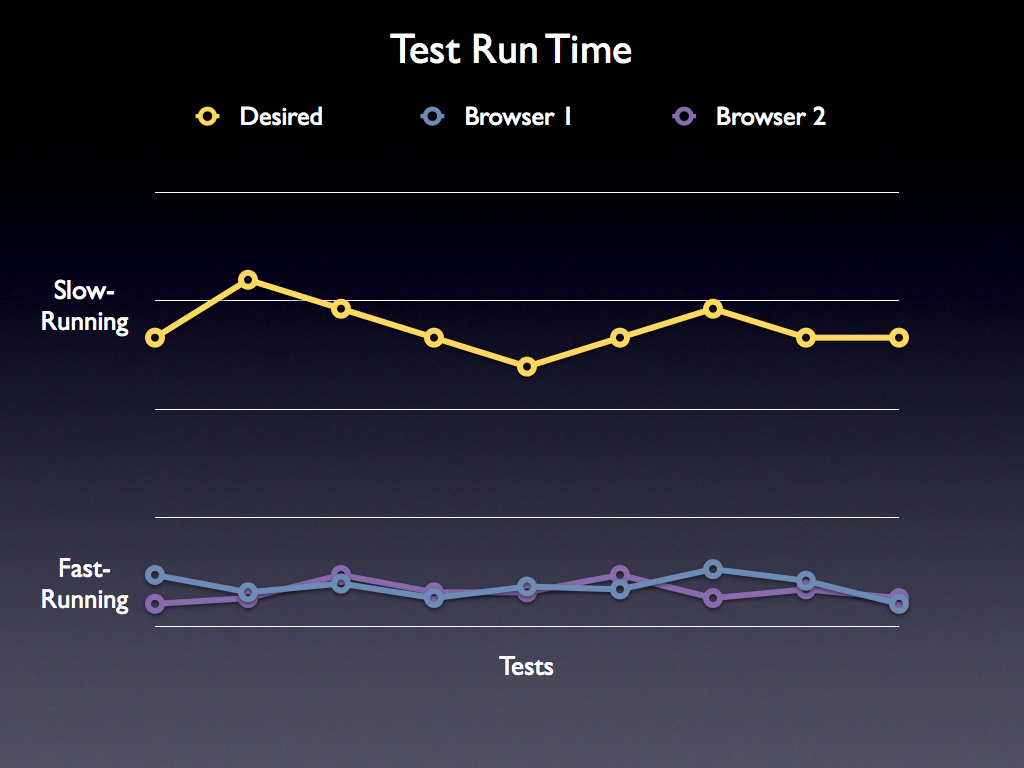
Slow-running tests: These tests generally take a couple hundred milliseconds on an average consumer machine. This is the style of tests that you generally see in SunSpider and occasionally in Dromaeo. These tests have a distinct advantage: They are generally quite accurate. You don't need to run them very many times (say about 5) in order to get a consistent picture of how the test will run.
Moderate-running tests: These tests take less than one hundred milliseconds. You'll see these tests in Dromaeo. These tests need to be run quite a few times (20-30) in order to get a better picture of their speed.
Fast-running tests: These tests take less than ten milliseconds. You'll see these tests in the V8 Benchmark and in Dromaeo. These tests must be run many, many, times (usually close to a thousand) in order to weed out any possible error. If you were to run one 10ms test 5 times - and get a single result of 11ms that would introduce a significant level of error into your results. Consider tests that take 0-1ms. A deviation within that range can instantly cause error levels around 50% to occur, if enough test iterations aren't completed.
Looking at the above categories the solution seems obvious: Use slow-running tests! You get to run them fewer times and you get accurate results - everything's peachy! But here's the problem: The speed of JavaScript engines are increasing at a rate faster than test suites can adapt. For example, SunSpider was initially developed with all tests running at equal speeds on a modern computer. Now that speed improvements have come along, though, (WebKit improvements, then Mozilla, then SquirrelFish, then TraceMonkey, then V8) those results don't even remotely resemble the tests of old. Most of the results have moved down into the moderate-running range of tests, some even into the fast-running range - but here's the problem: They're still only running the originally-designed number of loops. An example of the difference:

This means that a browser is running a test for 5-10 loops (in both SunSpider or Dromaeo) but the speed of the test no longer matches that assigned number of iterations. At first glance you could say one of two things: 1) Increase the difficulty of the tests or 2) Have them run for more iterations. There are problems with this, though.
While you certainly could increase the complexity of existing tests the result would be a never-ending battle. Improvements would have to land every couple months in order to keep up with the pace of improvement. This would work ok in Dromaeo (since it has versioned tests) but not all suites can handle this behavior. Additionally this now makes the tests less-useful for measuring slower browsers (the tests now take an absurd amount of time to complete as opposed to the very-plausible numbers from before).
Additionally, you could increase the number of test iterations that would occur but not without assigning specific iteration counts to each individual tests. And this is the full problem: How do you know what numbers to choose? Raising the number to 20 iterations may help one browser - but what about another browser which will need 100 iterations to get a proper count?
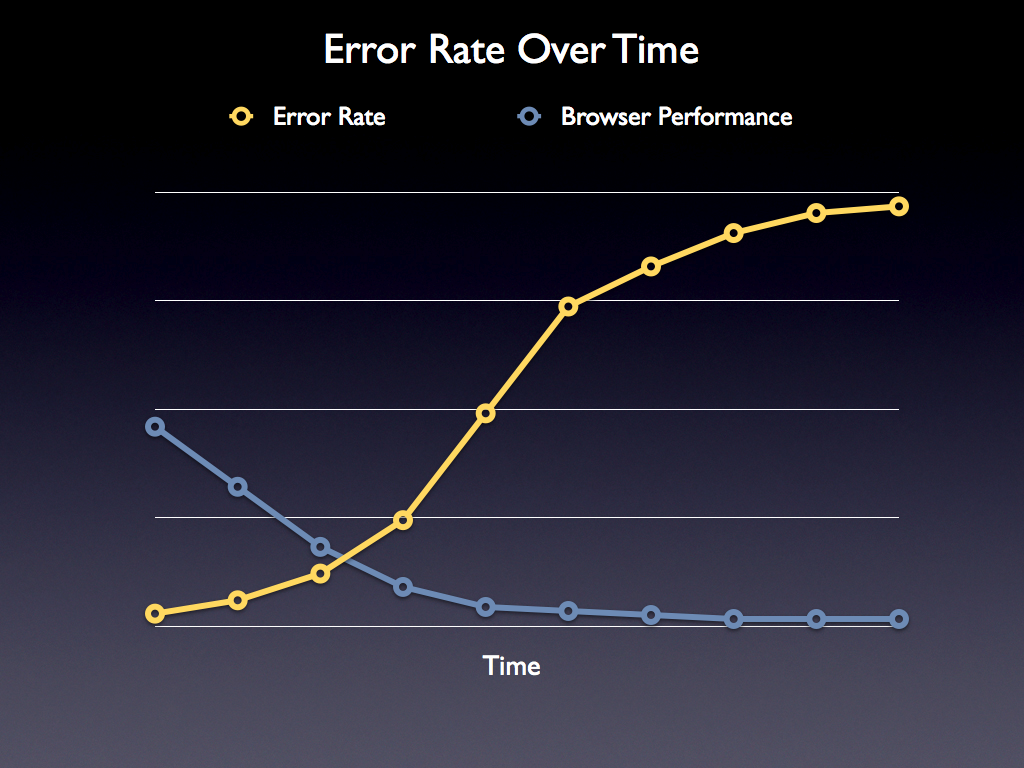
This leaves us in a bind. Browsers keep getting faster at tests, test suites do the wrong number of iterations, causing the error level to continually increase:

We should take a step back and look at what the test suites are doing to counter-act the above trend from happening - if anything at all.
SunSpider was originally dominated by long-running tests running 5 times each. The tests use to be long-running but are now only in to the medium to fast-running range (depending on the browser). This has caused the accuracy to decrease and error level to increase. Increasing the number of iterations would help (but hinder older browser performance).
Dromaeo has a range of tests (fast, moderate, and long-running) each running 5-10 times each. Dromaeo attempts to correct the number of iterations run, right now, but kind of fails when doing so. It looks at the results of past iterations (especially the error level generated by the results) and decides to run more tests until a stable error level is achieved. The problem with this is the samples are no longer being independently determined. Whereas test runs 1-5 were independent, test runs 6-10 were not (they're only being run due to the fact that previous test runs provided poor results). So while the results from Dromaeo are hyper-stable (they're the most stable performance test that we run at Mozilla) they're not determined in a proper statistical manner. Thus Dromaeo needs to be changed in order for people to be able to gather accurate results without sacrificing its statistical integrity.
The V8 Benchmark takes a completely different strategy for its fast-running tests: Instead of running for a pre-determined number of iterations each test is run continuously until a second of time has passed. This means that individual tests frequently run anywhere from 50-200 times (depending on the machine and browser they run on). Currently the V8 Benchmark does suffer from one shortcoming: There is no error calculation done. Both SunSpider and Dromaeo fit the results to a t-distribution and compute the possible error of the results whereas the V8 Benchmark just leaves them as is.
However, the V8 Benchmark does bring up a very interesting strategy. By picking tests that are simpler (and, arguably, most current complex tests will become "simple" as engines rapidly improve) and running them more times (relative to the complexity of the test) the results become much more stable.
Consider the result: Fast-running tests end up having a smaller error range because they are able to run more within a given allotment of time. This means that the test runner is now self-correcting (adjusting the number of iterations seamlessly). Since all JavaScript engines are getting faster and faster, and complex tests are running in shorter and shorter amounts of time, the only logical conclusion is to treat all tests as if they were fast tests and to run them a variable number of times.
We can test this hypothesis. I've pulled together
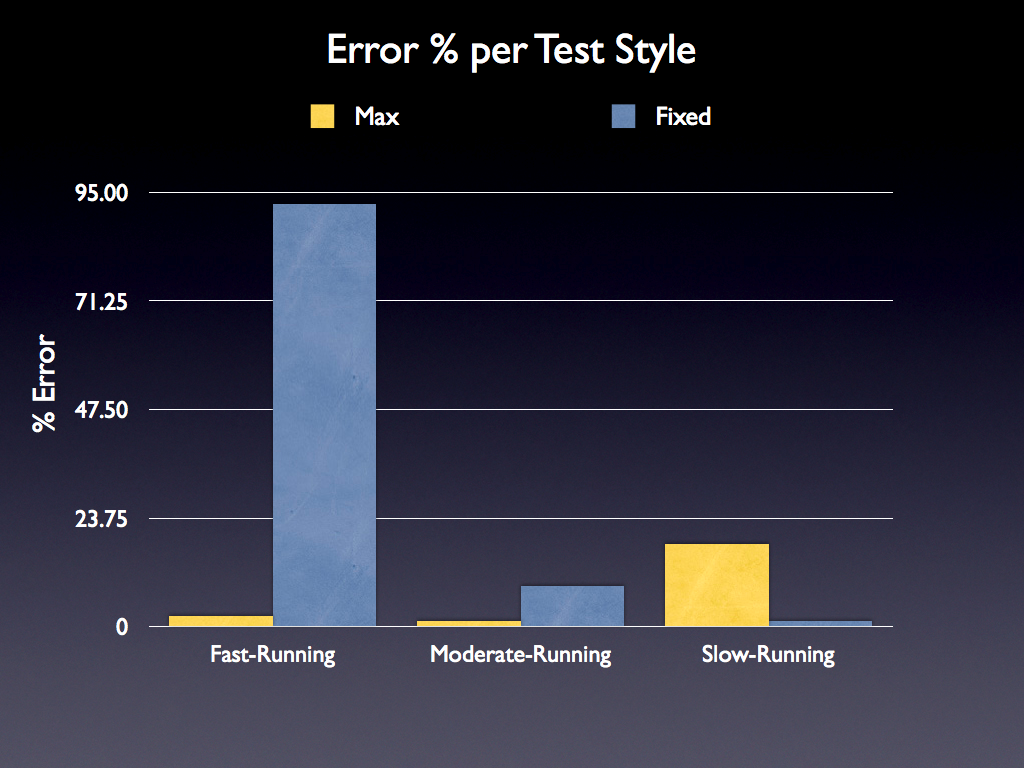
a simple demo that tests the computational accuracy of the three styles of test (Simple - or Fast-running, Moderate, and Complex - or Slow-running) against the two different types of suites: "Max" style (the style implemented by the V8 Benchmark) and "Fixed" style (the style implemented by SunSpider and Dromaeo). The results are quite interesting:

Fast and moderate-speed tests are incredibly accurate with the max-style of test running. Often their error is no more than 2% (which is really quite acceptable). The quality degrades for the complex tests, but that's ok. Complex tests could be tweaked to consume less resources (thus allowing them to iterate more times and become more accurate).
Right now the accuracy of slow-to-moderate tests in fixed run test suites are suffering from increased rates of error as the engines get faster (as can be seen in the above chart).
The major change that would need to be made to the flexible style of execution (at least the one implemented in the V8 Benchmark) would be some form of error checking and t-distribution fitting. In V8 a series of tests are run over the course of one second. I propose that the resulting number (the total number of tests executed) be saved and the tests are repeatedly run again (perhaps 5 times, or so). The resulting set of 5 numbers (representing, potentially, thousands of test runs) would then be analyzed for quality and error level. I have this measure completely mocked up in my
sample test measurement.
The relevant portion of the code is here:

function runTest(name, test, next){
var runs = [], r = 0;

setTimeout(function(){
var start = (new Date).getTime(), diff = 0;

for ( var n = 0; diff < diff =" (new">
Switching to a flexible style of text execution has many benefits:
It'll help to keep the rate of error small for most tests (especially if the tests are tailored to be smaller in nature).
It'll allow the suite to gracefully adapt over time, as engines speed up, without sacrificing the ability to work on old engines.
The maximum number of runs (and, thus, the maximum amount of accuracy) will occur for the engines that are able to complete the tests faster. Since the greatest amount of competition is occurring in these high numbers (as opposed to in older user agents, where there is no progress being made) granting them the most accurate numbers possible makes this ideal.
I plan on prototyping this setup into Dromaeo and releasing it shorting. It'll take much longer to run the full test suite but the result will be quite worth it.
Posted: September 6th, 2008 · Tags:
webkit, tracemonkey, v8, javascript, mozilla

-->